


Hold My Beer Jake (Or How We Save This Profession.)
Rayburn 'Jake' Donaldson - This is all your fault. You made this post, and then I had a few things on my mind. So in response to your question - please hold my beer.
Have you ever seen the SNL skit Black Jeopardy where Darnell reads from the category "Big Girls"? "Skinny women can do this for you." ,and contestant Doug buzzes in to answer, "What is not a damn thing!" He might as well have been asking about The American Institute of Architects (AIA) .
The last thing I saw from them was an update to subcontractor contract language. Not subconsultants. Not anything particularly useful to actual rank-and-file architects. No sir, we need to make sure we have robust contract language for plumbers and electricians. I've done this for almost 20 years, and you know how many plumbers have asked me for help - or better yet paid me to draft - a subcontractor agreement. None. Not one.
Maybe somewhere a lonely metal fab guy is paying a sole practitioner architect a market rate fee to assist in drafting this contract so that architect can afford the obscene annual AIA contract subscription that forces us to use a trash interface. Or better yet, maybe it’s helping us afford the doubly obscene cost of spec writing through an equally trash software - all of which is a blatant money grab on top of annual dues.
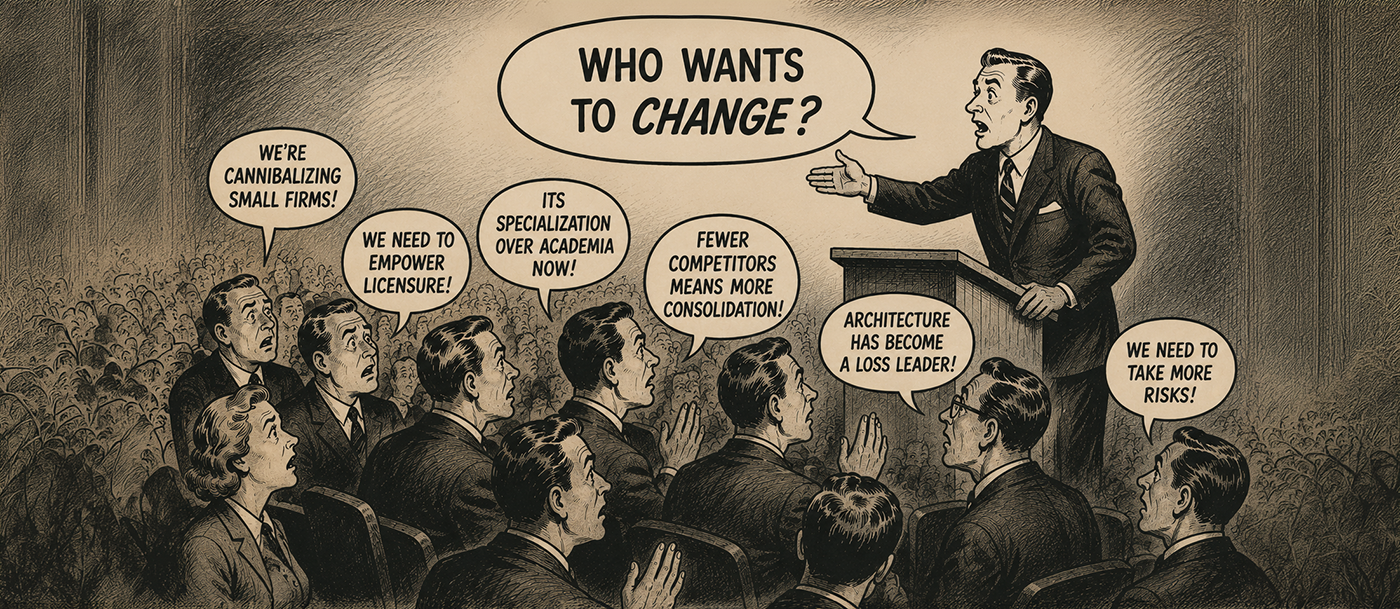
Where is the AIA when private equity consolidated some of the top architecture firms in the country into engineering? Where was that white paper? Consolidation for efficiency inherently means less architects - which is fine. Economics will do what it does. But the flipside is consolidation of portfolio. Fewer firms with competitive portfolios means fewer competitive responses means more consolidation. We see this in our own markets in Houston. Why is a 500-personfirm submitting on a tiny project- because they can.
This is not a cycle. This is the new economic standard for our profession. Architects relegated themselves to art when they stopped performing well rounded services. And this is now the dead end we've created for ourselves. Engineering based fees for maximum efficiency because architects can't seem to turn a profit for themselves.
Sure, there will be the glorious milestone projects that need 5,000 person firms to pull them off. But the race to the bottom starts with the continued cannibalization of our profession.
The 10% fee for basic design is gone and it’s not coming back. We are not 41 months into a downturn in billing. We're 41 months into a fundamental transformation of the profession that looks like lower direct architecture fees while design becomes a loss leader for "full service" engineering firms to cash in.
Firms don't care about licensure. It's not a thing when you're in full production mode and don't necessarily need individual thought and ownership of an idea. The machine will take care of QA/QC. God bless that a P.E. can take their E.I.T. test and then have one more specialty exam. Why would you bother to take 6 when you can take 2? In turn, we now get first year graduates salivating at $80,000 salaries that only the biggest firms can support while totally forgetting that this profession is based in apprenticeship. Who wants to wait to learn more after graduating when there is money to be made now? Moreover, who wants to go through the rigor of actually learning a broad set of skills when you can specialize into value immediately?
The article is laughable too in so far that the AIA sold themselves out to a sponsor company whose billing software is universally hated by every architect that has ever used it. Free plug Monograph and Unanet, if you guys got together and made a software baby with Monograph's interface and Unanet's power you would have a golden ticket to sponsor the AIA's next billings report.
Oh, while I'm at it. Where is the AIA on making our Architecture a professional degree again? Where is that outcry?
There is no solution to waiting for something to change. We've got a client right now, who I kid you not, in one of our first interactions told me something that I'll never forget. He goes, "Alec, there are two types of people in this world. Guys who ask what the fuck happened, and Guys who get shit done. You'll want to be the latter."
I can soap box on this more, but the solution to your rhetorical question in your post is that Architects need to find themselves again and start taking more risks. It’s that simple. Pick the risk you like, but we need to offer more and stick our neck out more. We've spent generations of talent and almost a century backing ourselves as a profession into a corner by shirking off as much risk as possible. We are not the master building. We don't do schedules. We don't engineer anything. We don't actually do most of what defined us as a profession when the AIA was formed. We're artists - with a minor dose of permit experience to boot.
Project Luong took the route and went full developer architect and didn't lookback. Control the money and proforma and the rest becomes much easier. We take risk and invest in our own work - partially to demonstrate our own commitment and partially to reap the financial rewards otherwise left on the table. In the race to the bottom there is no way to compete in a world with firms that have portfolios thousands of projects deep. No small firm is going to be competitive in that environment. As small firms, we must distinguish ourselves. And the one thing we can do that nobody can stop us, or really compete with us, is in managing our own risk profile.
We look for architects that understand the basics of finance. I've had over a dozen conversations with different architecture school deans pushing them to deliver architects with basic finance or real estate certificates. It's like pulling teeth, but right now I'll take a kid with one less architecture elective theory class and a few more finance classes any day. Hell, we've made the profession so hard to get into (which is a totally different story), that in five or six years of education we should be able to squeeze in something useful.
Leveraging into development helps us as architects control the project from phase zero. It also opens up an entirely different revenue stream beyond the confines of what a traditional architect does. Again, there is no way we're going to go out and create entire think tank divisions to expand on what the power of design will do. But we can take development project managers and pair them with licensed architects to create real value for projects and avoid adding another "consultant" to our project team.
The additional revenue stream also allows us to stay competitive with larger firm salaries. Firms don't want to invest in licensure for staff because they're already giving up on the idea that they can't or won't be able to retain that talent in the future. Why spend all of this time to get someone licensed when they're just going to jump ship when they want apay raise anyways. I totally get that perspective. Part of what we do is immerse our new architects in the development side of the world as soon as they join us. We've got Architect interns working proformas and doing details in the same summer. We've got to find a way to keep the youngest of our staff engaged and interested to differentiate between what we do as a firm and what you could do somewhere else.
And lastly, and probably the most important part to this rant - we've got to be better as Architects at sharing wealth with staff. How many firms formed in the 90's in Houston are going to be around in the next 10years as that entire generation retires out? I can sit here and rattle off a handful that we've been approached to purchase outright. Succession planning at year five has been as much of a focus as has been growing the actual firm. We need to be able to show the 23-year-old how they can become a partner, and reinforce that message every day as they grow with us over time. It’s a crazy thought that my own retirement depends on a kid that just graduated this year - but that is the reality of how this will work unless I take the private equity juice too and sail everyone else down the river.
I'm sure this is going to get a chuckle out of some, and mass irritation out of others. This is a changing profession. And it’s changing faster and frankly changing in the wrong direction sooner than anyone realizes. The private equity influence on design is real. The necessity of academia to change is real. If we expect to have a profession we love, care for, and are deeply committed to then we, as small firms and individual owners, must do something about it. We've got to share those ideas. We've got to empower those who compete with us to do them as well. There is no way to wait out a return to the good 'ole days. Those are gone. We're in charge now. Let's do something about it.


