


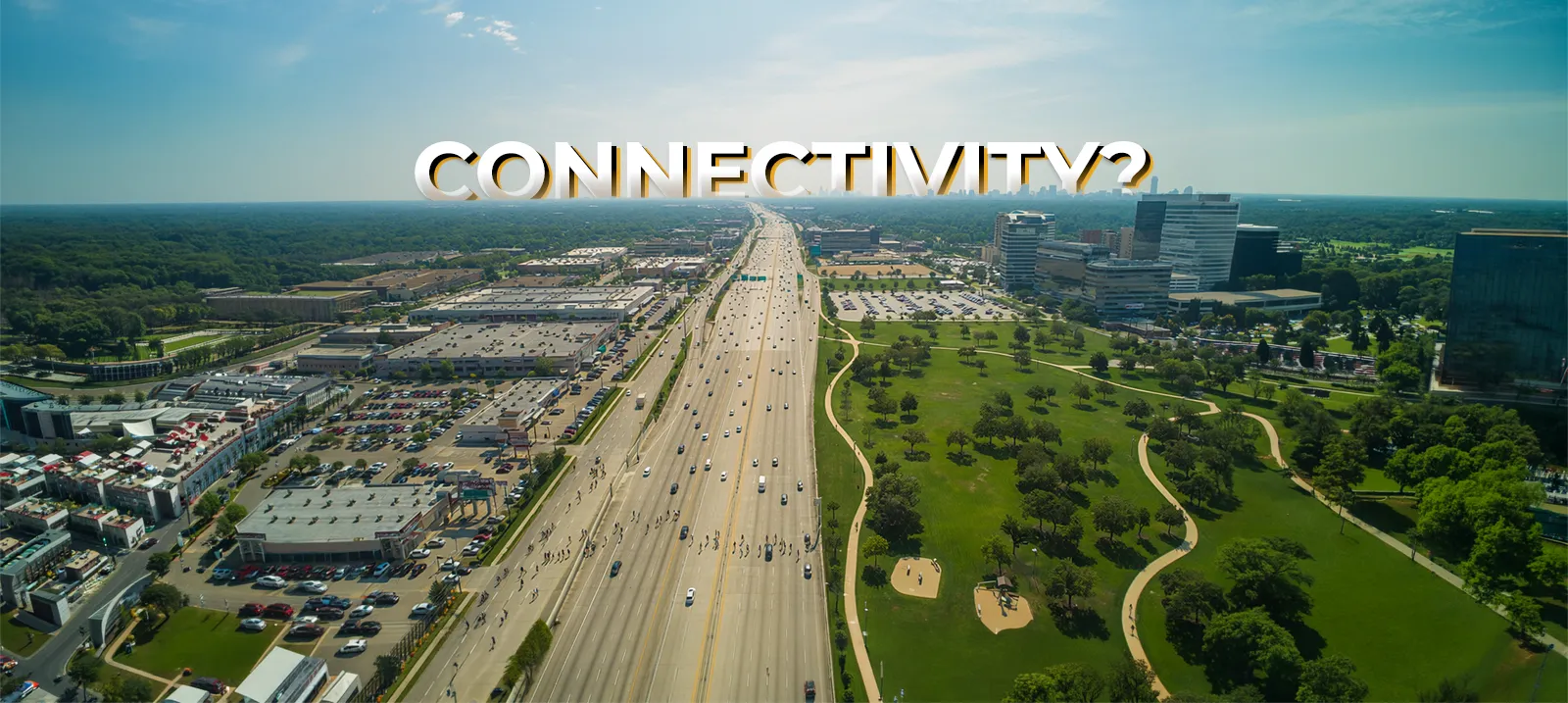
Houston's Isolated Green Islands
I recently read a post about the connection problem in Denver, Colorado. The author described how Denver’s trails system looks from above. From an aerial view, it appears seamless. Long trails stretching for miles, weaving across the city in a carefully planned network. However, once you’re on the ground, the story changes. Highways interrupt the routes. Massive parking lots break the continuity. Sidewalks end without warning.
The system looks connected but doesn’t feel connected.
As I read through the post, I couldn’t help but think; this isn’t just Denver’s problem. It’s ours too, right here in Houston. It’s because they share many of the same characteristics. As one of the largest and fastest growing cities in the country, Houston has built incredible parks and trail systems. Yet too often they exist as destinations instead of being a part of our daily lives.
The author makes a point that stuck with me. Cities don’t just need trail systems. They need systems that connect. Every neighborhood should feel like a trailhead. Instead of designing places you must load up and drive to, cities should design for connectivity.
Like Denver, Houston has beautiful parks and trail systems. (Just not as scenic in my opinion) For most of my life, getting to them meant loading up the car first.
Take George Bush Park and Terry Hershey, for example. If you grew up in West Houston, you probably know these trails well. I certainly do. I remember days when I was home from college, packing my bike up on the car and driving to the Briar Forest and Highway 6 parking lot. From there I would ride for miles, sometimes to the Harris County Constable’s office, to the Terry Hershey Memorial entrance and then back to the parking lot. It was always a great ride. I loved feeling the sun and wind hit my face and enjoying the occasionally clear blue skies. But at the end of it, the routine was the same. Load the bike back onto the car and drive home.
I remember another instance of the same problem with my now husband, who lived in the apartments at Briar Forest and Highway 6. When we wanted to ride, we would bike down Briar Forest, cut through the Briarhills neighborhood, and enter Terry Hershey at the smaller entry points, either at the recreation center or the back corner of the neighborhood. It technically worked. Still, it felt like we were navigating around the city instead of moving through it.
The obvious route would have been to simply cross Highway 6 and access the trail directly from there. But anyone who has seen that intersection or lives in the anchoring neighborhood knows why we didn’t. There’s no safe connection. No direct access to the parking lot. Just fast-moving traffic and the kind that makes you question your life choices. Would you try crossing Highway 6? Exactly.
Recently, I joined the West Houston Association’s Parks and Recreation Committee, and it’s been encouraging to sit at the table with people who care deeply about these same issues. Our conversations often revolve around the parks, neighborhoods, and trail systems we already have and how we can make them work better together. Because the truth is, Houston doesn’t lack parks.
We have incredible ones: Memorial Park, Buffalo Bayou, George Bush, Terry Hershey, John Paul Landing, and many more.
What we lack is connection.
For many Houstonians, using these parks still requires a 15-20 minute drive just to start walking, running, or biking. The trails themselves are wonderful, but they remain separated from the neighborhoods they’re meant to serve.
Imagine something different. Imagine stepping out of your front door, hopping on your bike, and reaching a trail within minutes. Imagine your kids safely riding from the neighborhoods to parks without needing a car ride first. Imagine a city where parks aren’t isolated green islands, but a part of the everyday lifestyle and movement.
That is real opportunity.
Solving the connection problem isn’t just about trails. It’s about rethinking how our neighborhoods, roads, and parks relate to one another. If we can start bridging those gaps, Houston’s park system could become something even greater. It won’t just be a collection of beautiful places, but a network that truly connects the city.
And maybe one day, the best part of the bike ride won’t start from a parking lot.


