


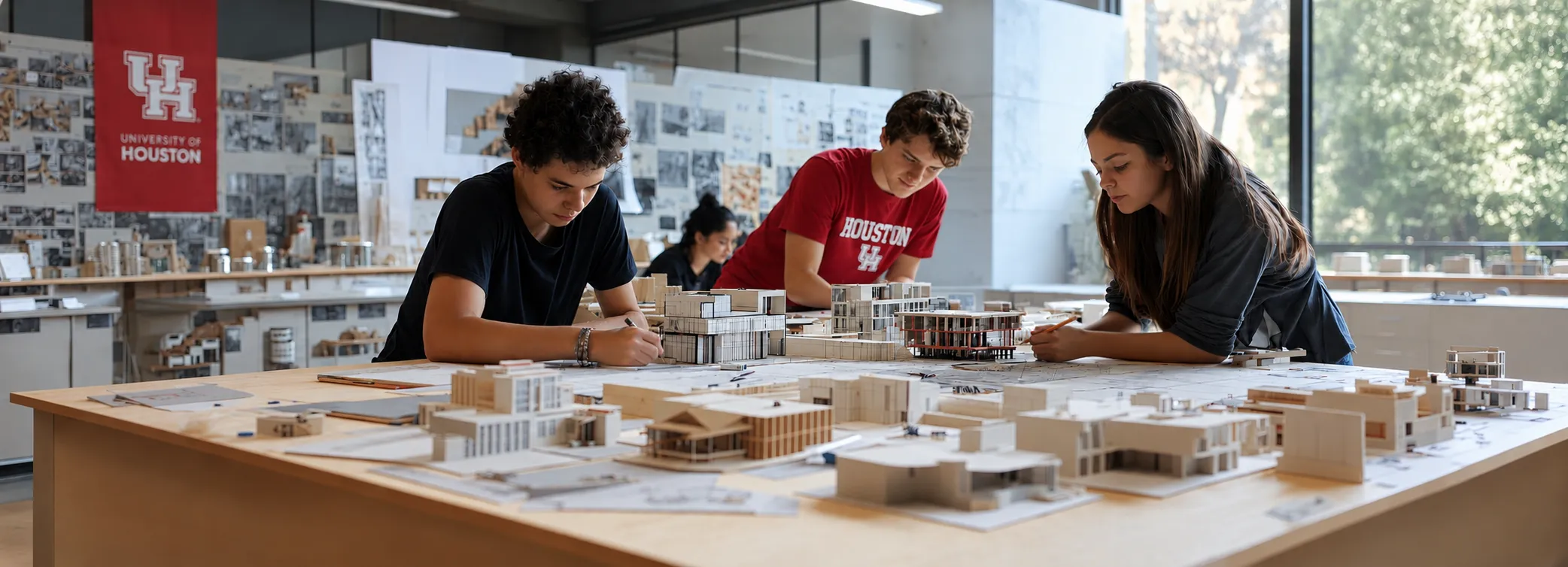
Revisiting Studio with a New Perspective
For the past few months, I’ve had the opportunity to return to my alma mater as a reviewer for my former professor’s master’s-level architecture studio at the University of Houston Hines College of Architecture and Design. Over several visits, I joined conversations around nearly a dozen student projects, offering feedback as they moved toward the culmination of their work.
The projects ranged from urban design proposals and residential prototypes to adaptive reuse concepts cumulating in an inspiring reminder of architecture’s breadth and possibility. Across this diversity of scale and typology, what stood out most was the importance of clear design intent. No matter the program or ambition of a project, its strength often depended on how clearly that intent was defined and communicated.
One of the most meaningful takeaways for me was a renewed understanding of presentation as an act of design in itself. Watching students articulate their ideas made clear how much a project’s impact depends on the relationship between narrative and graphics. When those two work in harmony, a concept becomes more legible, persuasive, and memorable. That observation has stayed with me and has influenced the way I communicate my own design decisions in practice.
I was equally struck by the range of perspectives brought by the other reviewers. Some came from academia, others from large firms and years of professional experience. I entered the room from a different vantage point, that of an early-career designer, and that contrast was valuable. It reminded me that the way a project is received is often shaped by the experiences, priorities, and frameworks each person brings to it. Design does not exist in a vacuum; it is always interpreted through the lens of others.
The experience also reinforced something deeply familiar to any designer: the tunnel vision that can emerge through prolonged iteration. In my role as a reviewer, I found that the most useful feedback came not from redirecting a project, but from first understanding its intent and then helping sharpen what was already there. That balance of staying true to a central idea while remaining open to refinement is a discipline that develops over time. Often, a fresh set of eyes is what helps a project move forward with greater clarity.
Returning to studio from the reviewer’s side also made me reflect on how much my own perspective has evolved through practice. Working in architecture has given me a deeper appreciation for the weight carried by every design decision, and it was meaningful to bring that awareness into conversations with students who are still forming their own approaches. There was something especially rewarding about offering guidance in a place that once shaped me so profoundly.
I’ve been fortunate throughout my journey to learn from mentors who continue to influence the way I think about design, including Professor Dietmar Froehlich. Experiences like this remind me that architecture is shaped not only by the buildings we create, but also by the people who challenge, encourage, and guide us along the way. Returning to studio reaffirmed my belief in the value of mentorship and made me grateful for the chance to contribute, in some small way, to that ongoing cycle of learning.


