McKinney Airport Terminal

McKinney Airport Terminal
CLIENT
MCKNNEY AVIATION GROUP
SECTOR
DEVELOPMENT
AVIATION
STATUS
CONCEPTUAL

McKinney National Airport has served North Texas as a general aviation airport since its establishment in 1971. Over the past decade, the City of McKinney has taken several steps to position the airport for long term growth, including acquiring the airport’s fixed base operator in 2013 and purchasing approximately 190 acres of land east of the runway in 2018 to support future aviation development.

In May 2023, voters rejected a $200 million bond proposition that would have contributed funding toward a new commercial passenger terminal. The proposed bond would have supported a roughly $300 million terminal development intended to introduce commercial passenger service to the airport. Nearly 59 percent of voters opposed the proposition, halting the project as originally planned.

Following the bond’s failure, the McKinney Aviation Group engaged Project Luong Development to explore how the project could still move forward without relying on taxpayer funding. By combining architectural planning, aviation operations strategy, and private development structuring, the team prepared a proposal demonstrating how a new passenger terminal could be delivered through a privately financed development model.

The Design

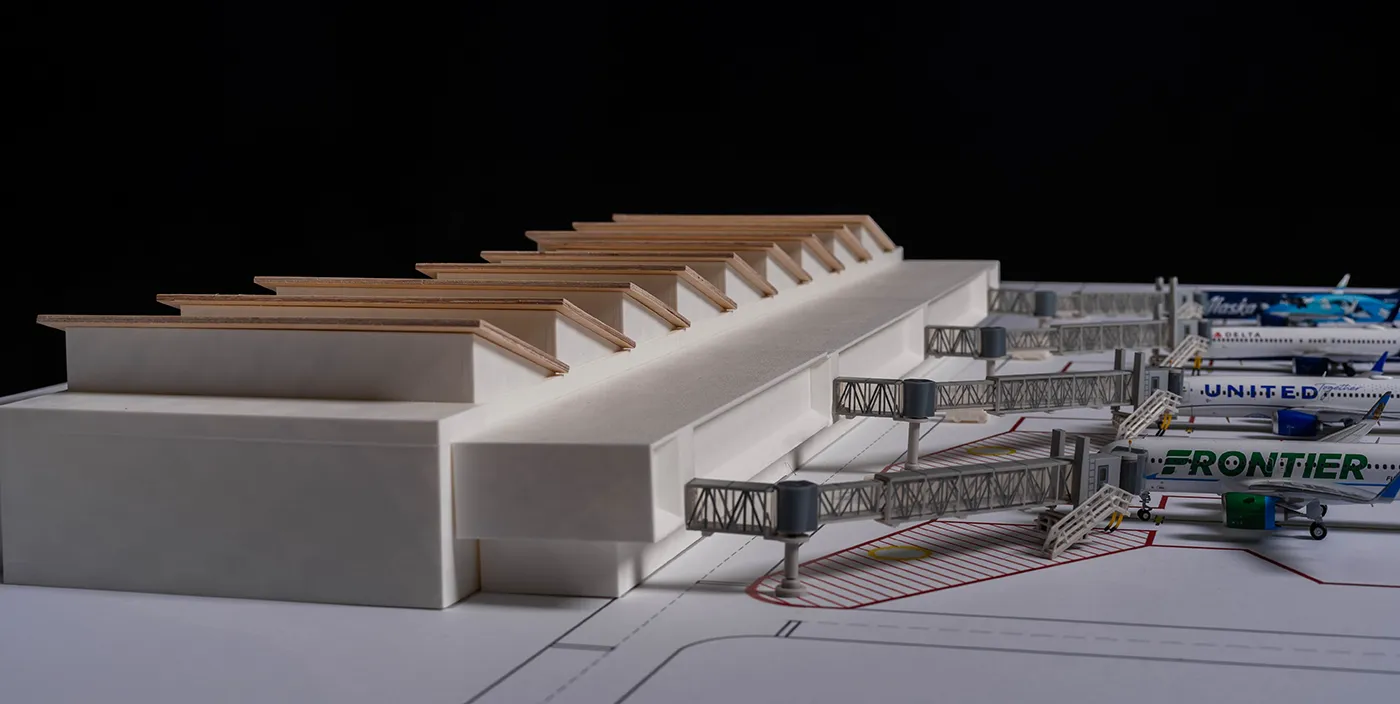
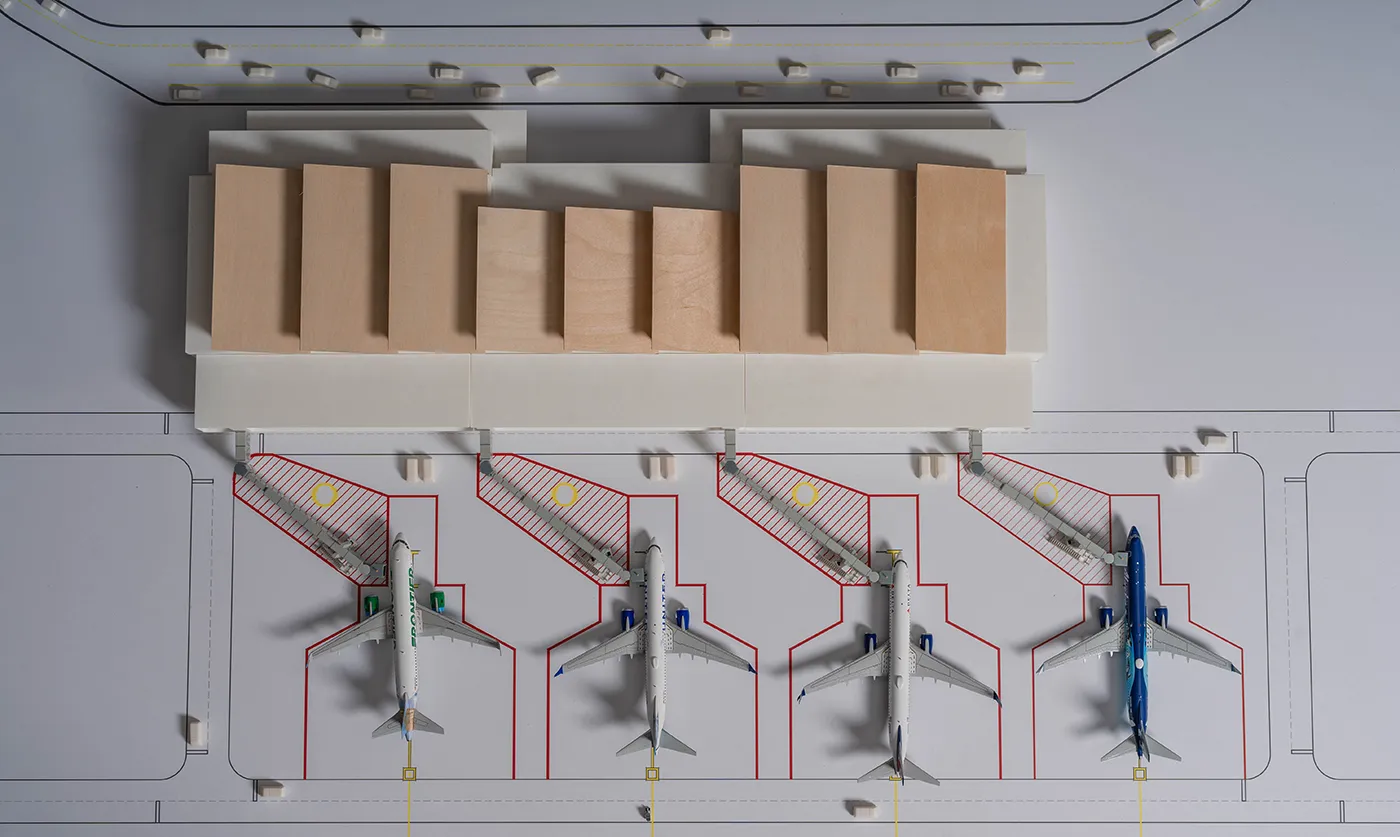
The proposed McKinney Airport Terminal is located along the east side of the runway on land previously acquired by the City to support long term aviation expansion. The terminal is organized as a linear concourse that aligns directly with aircraft parking positions along the apron, allowing efficient boarding and deplaning through jet bridges while maintaining clear aircraft circulation across the airfield.

Architecturally, the terminal is defined by a rhythmic series of angled roof planes that form a distinctive folded roof profile across the length of the building. This architectural gesture creates a recognizable identity for the airport while also serving practical functions. The repeating roof geometry allows natural daylight to enter the departures and arrivals halls while creating structural depth and shading across the terminal façade.

Inside the building, passenger circulation is organized into clear zones for ticketing, security screening, departures, and baggage claim. The terminal layout separates arrivals and departures while maintaining clear sight lines that simplify wayfinding for passengers.

The modular structure of the concourse allows for phased expansion as airline service grows. Additional gates can be added along the apron edge over time, allowing the airport to scale operations while maintaining operational efficiency and construction flexibility.

Together, these architectural strategies create a terminal that balances the operational requirements of commercial aviation with a civic presence appropriate for a regional gateway.

No items found.
No items found.

Development Strategy

The development strategy behind the McKinney Airport Terminal proposal was centered on a single objective: deliver the infrastructure necessary for commercial passenger service without requiring taxpayer funding.

Project Luong Development collaborated with McKinney Aviation Group to structure the concept as a privately financed terminal development that could be delivered through a public private partnership model. Under this structure, private capital would fund the design and construction of the terminal infrastructure while the airport would maintain operational oversight and long-term ownership of the airfield.

This approach allows the City of McKinney to advance its aviation ambitions without placing additional financial burden on residents following the rejection of the previous bond proposition. By separating terminal development from municipal financing, the proposal demonstrates how large-scale infrastructure projects can move forward through innovative development structures.

The terminal’s phased design further supports this strategy. Construction can occur incrementally as airline service commitments and passenger demand increase, allowing the airport to grow responsibly while minimizing financial risk.

No items found.
No items found.

No items found.
No items found.

No items found.
No items found.

No items found.
No items found.

RESULTS + VITAL STATISTICS